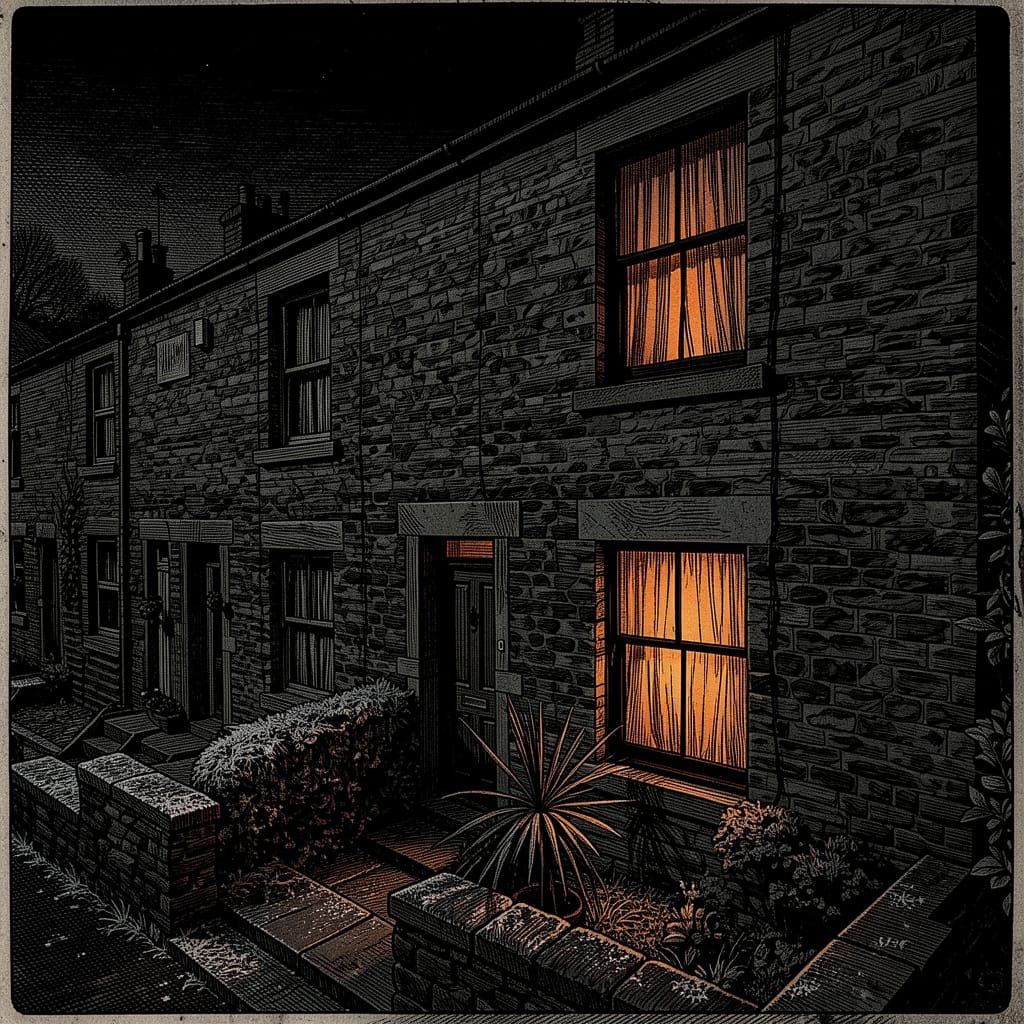
Stone terraced house, Haversage Road, Hope's End, Derbyshire.
13 Haversage Road is a stone terraced house on a quiet road in Hope's End, the small Derbyshire village in which much of the Book of Thoth Saga is set. It is the home of the brothers Ben Knight and Toby Knight, and of their nephew Robert Knight, whom they have raised at the address since infancy.
The house is the principal domestic setting of Cambion. A great deal of the novel takes place inside its kitchen, on its narrow stairwell, and in its three small bedrooms. Outside the family it is unremarkable; inside it, very little is.
Number 13 sits part-way along Haversage Road, one of the older residential streets of Hope's End. The terrace is built of the rough gritstone characteristic of Peak District villages: weather-darkened, narrow-fronted, two storeys above ground, with a slate roof, single-glazed downstairs windows, and a small porch lantern beside the front door. A garden gate opens onto the pavement at the front; the back of the property gives onto a small yard.
The kitchen is the centre of the house. Its walls are ceramic-tiled; its floor is brown-and-orange patterned linoleum, worn through to a black underlayer in the patch by the sink. The chairs are 1970s brown vinyl, cracked along the seat backs. The wooden table carries the gouges, mug rings and old pen marks of years of family use, including, near one corner, the dent left by a toolbox of Ben's. There is a gas hob with an old whistling kettle whose spout has blackened with use, a fridge that hums perpetually, and, above it, a cheap plastic novelty wall clock cut in the shape of a fried egg, with two bacon-rashers for hands. The kitchen window looks onto the small November garden behind the row.
The hallway runs from the front door past the foot of the stairs to the kitchen. The stairs themselves have, over eight years, taught the family their habits — the third stair groans only if trodden on its edge; the pipes in the wall judder three times before the hot tap surrenders any water; the back door, swollen with successive winters of rain, refuses to latch unless slammed twice. The living room sits to one side of the hall: a sofa, a television, a sideboard with a record player, heavy curtains kept drawn against the afternoons. Its walls are lined with books, stacked, shelved and wedged sideways across most of the available surfaces. Since November 1995 it has, by quiet domestic arrangement, doubled as Robert's schoolroom, with a low coffee table acting as a desk.
Three bedrooms open off the upstairs landing — one for each Knight. Robert's contains an Alan Shearer poster from his Blackburn years, a peeling poster for Batman Forever, faint glow-stars affixed to the ceiling, and a single framed photograph of his mother on the nightstand. The atmosphere of the house, on a quiet evening with the radio on and the kettle going, is the atmosphere of any number of small Derbyshire homes of its age and class: warm, spare, slightly draughty. Visitors find it ordinary. The Knights, who live in it, have come to feel otherwise.